


What's going on in this picture?
The Digital Museum of Learning is pleased to share a growing series of resources designed for children aged 7 to 12 to explore images through observation, discussion, and creative response.
By engaging with artworks, learners develop attention, curiosity, and confidence as they interpret what they see, relate it to their own experiences, and express their ideas in different ways.
This series is grounded in visual literacy – the ability to interpret and create meaning through images.
Each activity invites children to spend time with an image, observing carefully before moving into interpretation, personal reflection, and expression. The process encourages learners to explain their thinking, consider different perspectives, and become aware of how they construct meaning.
The approach draws on practices such as Slow Looking, Visual Thinking Strategies (VTS), Thinking Routines, and inquiry-based observation, while also supporting metacognitive reflection.
How the activities are structured
The activities follow a consistent learning process:
Observation | Look closely. Learners begin by noticing details, patterns, gestures, and visual elements, developing attention and curiosity.
Interpretation | Build meaning. They explore what might be happening in the image and why, backing up their interpretations with visual evidence.
Connection | Relate to experience. Learners connect the image to their own lives, questions, and ways of learning, making the experience more meaningful.
Expression | Share understanding. They communicate their ideas through speaking, writing, drawing, or making, discovering different ways to express understanding.
Why this matters
Images shape how children understand the world, yet the skill of looking is rarely taught explicitly.
In a context of constant visual stimulation, learning to slow down and think carefully about images becomes essential. When children engage deeply with what they see, learning becomes more active, reflective, and memorable.
The capacities that visual literacy draws on – attention, reasoning, empathy, and communication – are valuable across many subjects, from interpreting scientific diagrams to analyzing historical images, especially when teachers help learners carry these habits from one context to another. The approach also supports inclusive learning by valuing multiple perspectives and the different ways children make and express meaning.
This growing series connects image-based learning with themes from our exhibitions. Each activity puts the spotlight on an artwork — drawn from our partners' collections around the world, or from the public domain.
Currently available:
More resources will be added to the series soon.
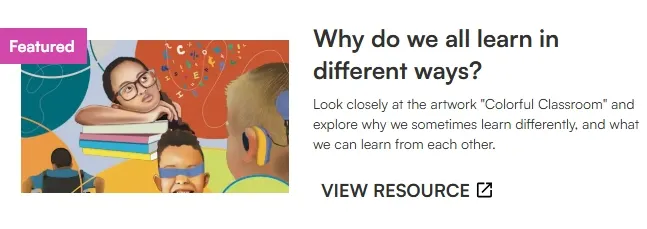
Why do we all learn in different ways?
Based on Colorful Classroom by Ariane Jackson (2024), from Embracing Our Differences.
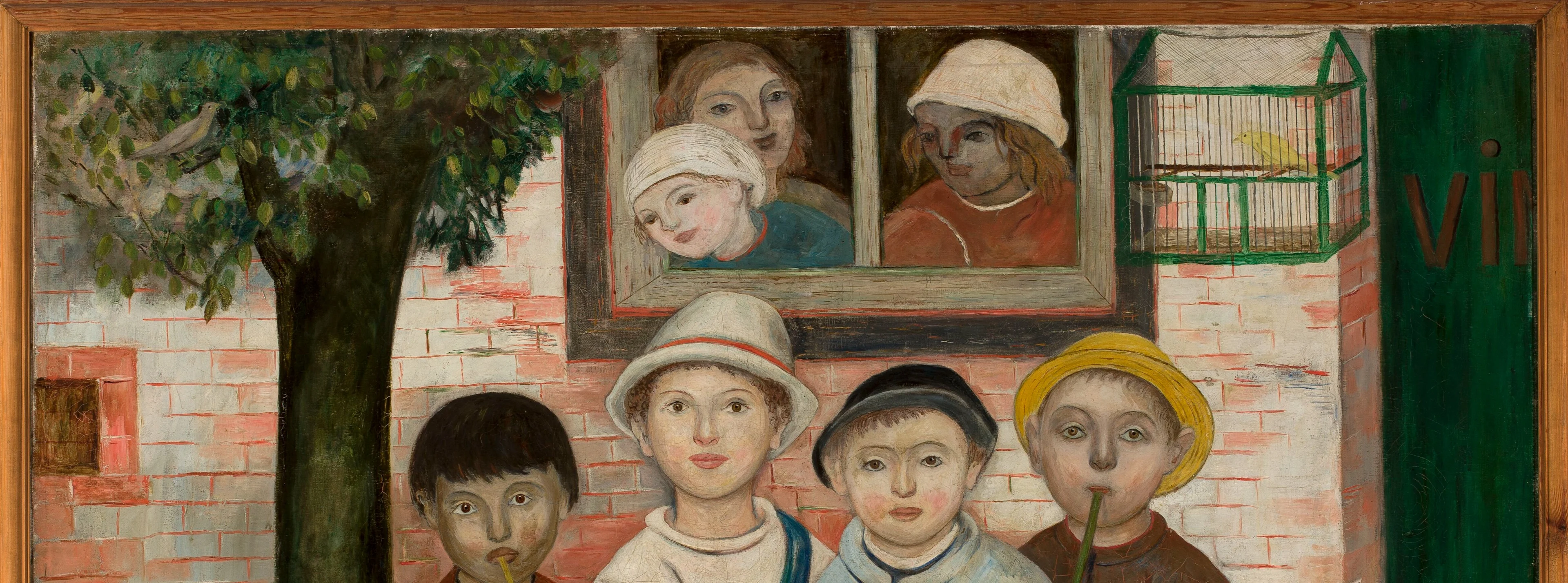
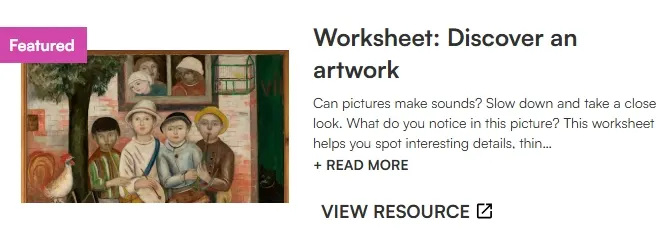
What sounds can a picture hold?
Based on Children’s Band by Tadeusz Makowski (1922), from the National Museum in Warsaw.
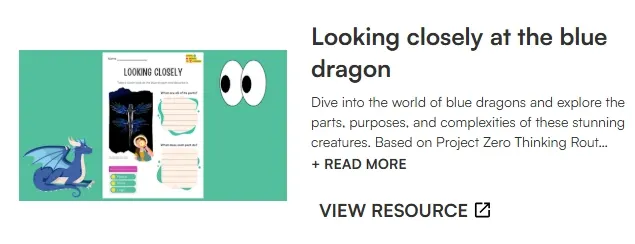
Looking closely at the blue dragon
Based on a photograph by Philippe Wagneur of artefacts in the Blaschka Collection at the Natural History Museum of Geneva.
Research informing this approach
This series is inspired by research in visual literacy, metacognition, and learning through observation, including ideas and practices developed by researchers at Project Zero and within the field of Visual Thinking Strategies.
Further reading
Lopez-Leon, R., & Thompson, D. S. (Eds.). (2024). Connecting visual literacy to theory: Revisiting the disruptions of visual thinkers in education and beyond. Routledge.
Perry, J., Lundie, D., & Golder, G. (2019).Metacognition in schools: What does the literature suggest about the effectiveness of teaching metacognition in schools? Educational Review, 71(4), 483–500
Tishman, S. (2017). Slow Looking: The Art and Practice of Learning Through Observation. Routledge.
Share with us!
Have you used these activities with your learners? Tag us at @dmolearning – we’d love to see the outcomes of their work!