



Meet Barbara Pape: Expert on Learning Variability
Barbara Pape is a former middle school teacher who spent years at the American Federation of Teachers and the National Board for Professional Teaching Standards before leading the Learner Variability Project at Digital Promise. She is the founder of the Center for Belonging and Learning and holds an EdM from Harvard Graduate School of Education. She is currently a PhD candidate at UCL Institute of Education.
We partnered with Barbara Pape to draw on her expertise in learning variability and help inform our story.

Could you explain what learning variability means in simple terms?
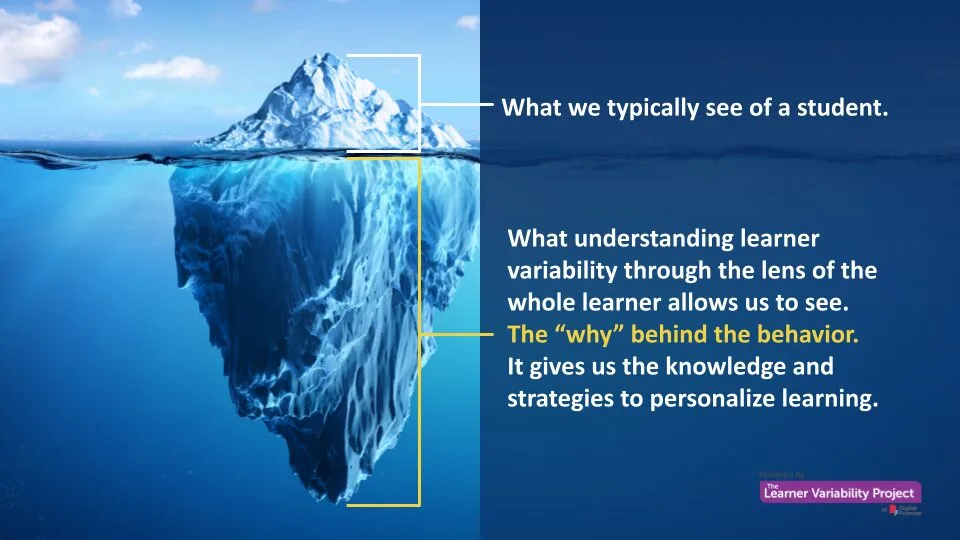
Learner variability can also be understood with the iconic iceberg visual. We typically only see the top of the iceberg – a student is not paying attention, is sleeping, or is distracting others. Understanding learner variability means we go beneath the surface to understand the “why” behind the behavior.
Rather than asking why some students struggle to fit the mold, learner variability asks us to rethink the mold itself.
What do you wish every educator, or every child, understood about learning variability?
I wish every educator understood that the student who seems hardest to reach is usually the one working hardest to be seen. Learner variability tells us that struggle is rarely about effort or ability. It's almost always about fit.
When a child isn't thriving, the first question shouldn't be "what's wrong with this learner?" It should be "what does this student need that we haven't yet figured out how to provide?"
In turn, I wish every child knew that their brain is extraordinary exactly how it is. The student who needs to move to think, who sees patterns others miss, who takes longer to process but goes deeper when they do – they are a powerful learner who can meet their potential.
Every child should understand their own learner variability and learn how to self-advocate for learning environments and teaching strategies that work for them.
What have you found are the biggest challenges educators face in understanding and implementing learner variability approaches in the classroom?
Educators are deeply committed to their students but the system around them often makes it hard to act on what the science of learning actually tells us. The challenges are real, and they operate on multiple levels.
Firstly, the myth of the “average” is deeply embedded. Most teachers were trained in systems built around a fictional "typical" student. Unlearning that framing and replacing it with a genuine appreciation for variability as the norm takes time and institutional support that is rarely provided.
The research is vast and hard to navigate. Teachers are expected to know how to embed research on what works into daily practice, often without meaningful support, which is why tools like the Learner Variability Navigator are so critical to bridging the gap.
Time and capacity are constant barriers. Differentiating for a wide range of learners requires planning, flexibility, and often, additional materials. In under-resourced schools where variability is frequently greatest those conditions are hardest to meet.
Finally, many systems still frame student differences as problems to be fixed rather than as starting points for design. Shifting toward a strength-based, neurodiversity-affirming lens is not just a pedagogical change; it's a cultural one.
The good news is that when educators do get the tools, language, and community to embrace learner variability, they often say it changes not just how they teach but how they see their students.
What first motivated you to focus on learning variability, and how have you seen the research impact educators and children in practice?
My path to learner variability began years ago when I was a middle school teacher in the US. I watched bright, curious students conclude, far too early, that they simply weren't smart. They weren't struggling because they couldn't learn. They were struggling because the system didn't yet know how to learn them.
That experience became the question that has shaped my entire career:
What would education look like if it started with every child's strengths instead of their deficits?
The research is remarkable – and remarkably underused. When educators finally get access to it in a form they can act on, something shifts. Teachers stop asking "why can't this student learn?" and start asking "what does this student need?"
I saw students’ faces light up when someone finally teaches in a way that matches how their minds work and respects them as human beings – that is something you don't forget. That is not a small change. It is the whole game.
Ultimately, children and their ability to understand themselves as learners and thrive in and out of school – they are the reason to continue the work.
Our story was inspired by Digital Promise's Learner Variability Navigator. Can you explain what it is and the problem it was designed to solve?
The Learner Variability Navigator (LVN) is a free, research-based digital tool that helps educators and edtech developers understand the many factors that influence how students learn. It synthesizes findings from across the learning sciences – cognitive science, neuroscience, social-emotional research, and more – and organizes them into an accessible, interconnected framework.
At its core, LVN maps the relationships between learner factors, things like working memory, motivation, social and emotional learning, language background, and stress, and connects them to teaching strategies and product design decisions. LVN is developed by Digital Promise with ongoing support from the Oak Foundation and, initially, from CZI, Overdeck, and Hewlett Foundations.

Could you tell us more about your involvement in the project with the Digital Museum of Learning? What motivated you to collaborate on the story “Design a robot that learns like you”?
What truly motivated me was the opportunity to bring learner variability to life, not as an abstract research concept, but as something children could explore and make their own.
So much of the work I do lives in policy papers, research frameworks, and professional development spaces. This project asked a different and more exciting question: what happens when you put these ideas directly in the hands of children?
"Design a robot that learns like you!" asks every child to do something radical, which is to look inward, to take their own learning seriously, and to imagine a future where classroom learning and technology is built around them rather than the other way around.

Design a robot that learns like you!
When a child sits down to design that robot, they are not just building a machine. They are declaring that the way they learn matters. That their needs are worth designing for. That their brain is worth understanding. That is learner variability made real.