


This charter marks the beginning of an ongoing journey of learning, collaboration and renewal. Together, as a community of museums in Switzerland, we commit to shaping a future in which our institutions are not only custodians of the past, but also vibrant laboratories for change.
Like the charter, we see museums as bridges between generations. The exhibitions of the Digital Museum of Learning connect research with the classroom and bring together perspectives from the past, present, and future of learning. They encourage children to explore ways to learn and thrive, share their own experiences, and join the conversation about what learning should look like in the future.
But a shared vision is only the starting point. Becoming a learning museum means asking ourselves questions such as:
How do we make learning part of everyday work?
How do we normalize experimentation and innovation?
How can museums learn from their audiences and from one another?
Our values as a starting point
Some of the charter's core values are already closely aligned with those that guide our work and shape every story we publish. These include curiosity, inclusion, collaboration, and a willingness to experiment. The courage to explore new approaches and challenge established ideas is also an important part of our work. The humility emphasized in the charter reminds us that we do not have all the answers and should remain open to learning from others.
The values of the Digital Museum of Learning
Children's Agency: Children are active participants in learning. We create opportunities for learners to ask questions, make choices, contribute ideas, and shape their own understanding.
Evidence-based: We build on research and evidence while remaining transparent about what we know and what we still need to learn.
Diverse perspectives: We value diverse cultural, social, and disciplinary perspectives. We encourage learners to see the world through different lenses and ensure that all voices have a place in our stories.
Curious: We believe questions are as important as answers. We spark curiosity, encourage dialogue, and remain open to questions. We are bold enough to ask questions that do not yet have answers.
Imaginative: We use creativity, storytelling, and the arts to transform information into meaningful learning experiences.
Collaborative: We learn with others through sharing, dialogue, participation, and co-creation.
By signing the charter, we commit to putting its core values into practice in our day-to-day work as a museum, while reinforcing and expanding on our own values.
The three questions below are at the heart of our thinking as we embark on this journey. We look forward to learning alongside other museums, sharing experiences, and gaining fresh perspectives that help us continue to grow and evolve our work.
What can we learn from our audience?
Since launching the Digital Museum of Learning in 2023, we've experimented with different ways of bringing the history and science of learning to children around the world. An important part of that process is understanding how visitors use and learn from the exhibitions we create.
For example, through an audience survey, we learned that educators in South America and South Africa are using our stories to support language learning, even though the stories are not designed specifically for language learning. That insight inspired us to create How do we learn new words?, a story developed with a language teacher and researchers to help children build vocabulary through evidence-based strategies.
This is one example of how feedback from our audience can inspire new ideas and shape our stories and exhibitions. The charter encourages us to create open channels for feedback, and regularly reflect on what we learn. The goal is not simply to collect data, but to learn from it and turn those insights into meaningful action.
What topics resonate across cultures?
Reaching schools across the globe has also prompted us to think more deeply about which stories resonate across cultures. Museums around the world are digitizing their collections. But making an object available online does not automatically turn it into a learning experience. It needs context. It needs a story that helps people around the world discover something meaningful in it for themselves.
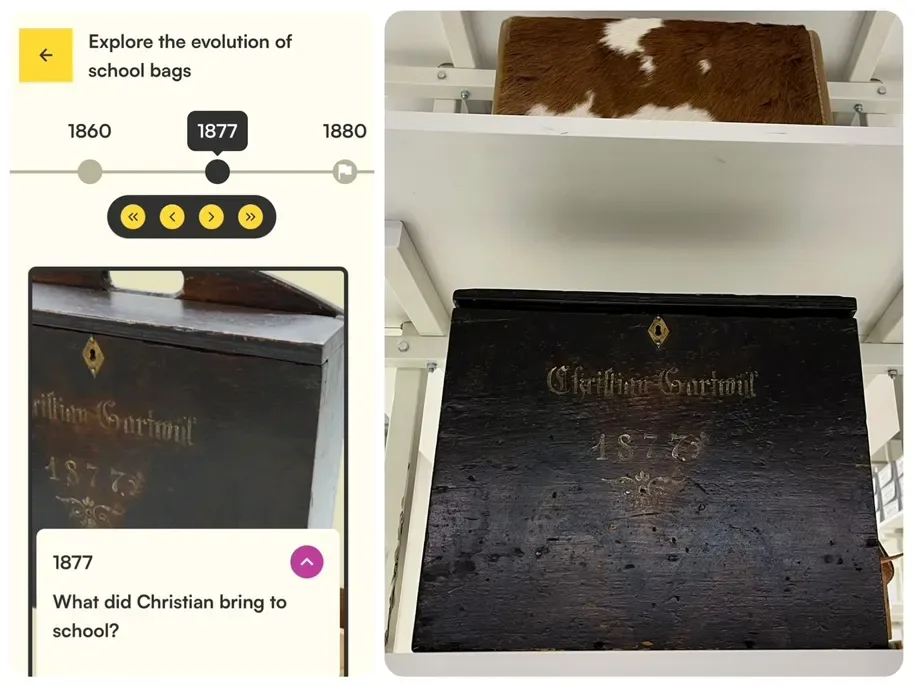
Take this school bag from 1877. In the exhibition at the Schulschaulager of the Schulmuseum Bern, it sits on a shelf as a museum object. In a digital database, it might appear as a photograph with a date and a description of the materials it is made from.
In the Digital Museum of Learning, it becomes the starting point for an investigation. Children look closely and wonder what a boy named Christian brought to school, and what he might have hidden in its secret compartment. Then they compare what Christian carried to school with what they carry today and explore how school life differs across countries and across time.
The object itself hasn't changed. What changes is the opportunity to connect the past with children's own lives and experiences around the globe.

In this approach, we see an opportunity to contribute to the museum field: exploring how museum collections can be transformed into digital learning experiences that draw on insights from the science of learning while connecting with the questions, experiences, and interests of young people. We also hope to collaborate more closely with other museums, experimenting with new forms of participation and developing content on socially relevant topics together with our audiences.
Rethinking the museum in a digital world
At the closing panel of the ICOM Schweiz and VMS conference in Liechtenstein in August 2026, Gesa Schneider of the Museum zu Allerheiligen in Schaffhausen shared a vision of the future in which museums become more open and evolve from fortresses into places of curiosity: spaceships that can fly and land somewhere new.
But what happens when a museum really does grow wings? What happens when its walls disappear and its visitors are no longer local, but global?
This is a question we think about often at the Digital Museum of Learning. As one of the first online museums among ICOM members in Switzerland, we are occasionally asked whether a museum that exists mainly online can still be considered a museum.
But being a learning organization also means letting go of assumptions that once seemed self-evident. Because learning has a less obvious counterpart. As Jacqueline Strauss, President of ICOM Switzerland, reminded participants at the same conference:
We always want to learn more, but we must not forget that we also need to unlearn.
For us, learning also means staying open to these questions and being willing to sit with the tensions and uncertainties they raise, rather than rushing toward answers that lead us back to familiar ways of thinking.
What comes next
Signing the charter commits us to developing a concrete action plan. We'll also join the initiative's second pilot group, exchanging experiences and approaches with other Swiss museums.
We look forward to sharing what we've learned from building a primarily online museum while drawing on the experience of institutions with different collections, audiences, and ways of working. There's plenty for us to learn from one another.
Learn more about the Charter of Learning Museums